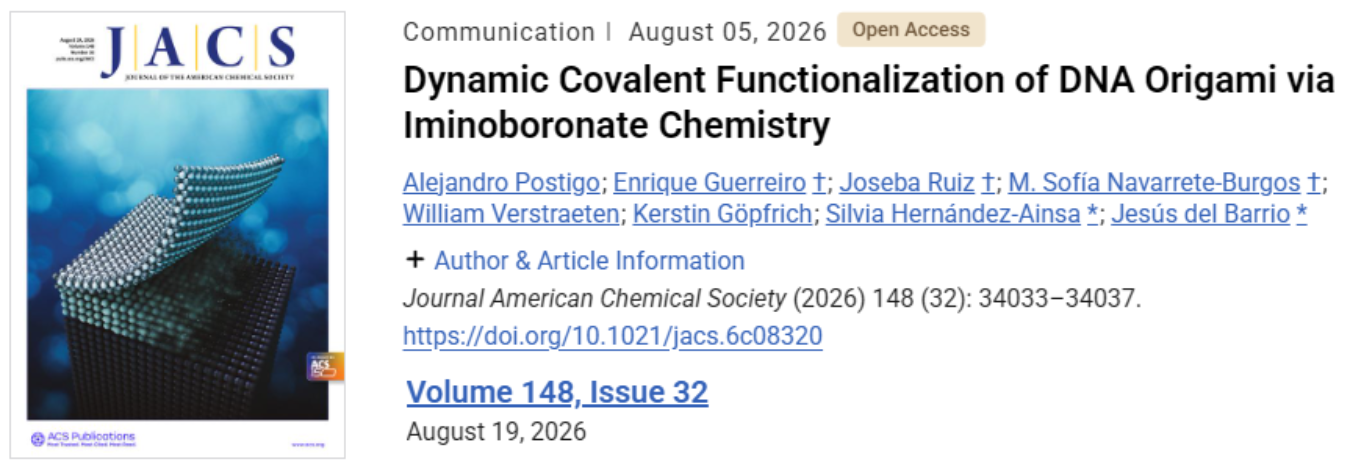
In a study published in the Journal of the American Chemical Society on 5 August 2026, researchers, including SynthImmune PI Kerstin Göpfrich and SynthImmune Doctoral Student William Verstraeten, introduced a new strategy for reversibly modifying DNA origami structures using dynamic covalent chemistry.
DNA origami uses DNA strands as building materials to create nanoscale structures with precisely defined shapes and functions. These structures can be equipped with additional molecules to give them new properties, but conventional approaches often rely on permanent chemical bonds. The researchers developed an alternative based on iminoboronate chemistry, which allows molecules to be attached and subsequently removed under mild conditions.
Using this approach, the team successfully attached polyethylene glycol (PEG) and cholesterol to DNA origami structures. Importantly, these modifications could be reversed by introducing a small-molecule competitor. The researchers also demonstrated that DNA origami could be reversibly anchored to lipid membranes, including those of large and giant unilamellar vesicles.
This approach combines the stability of covalent bonds with the flexibility of reversible interactions. It could therefore provide a versatile tool for adapting DNA nanostructures to changing environments and integrating them into more complex biological systems. In the long term, the findings could support the development of programmable nanodevices and adaptive biomimetic materials.
Read the full story here.